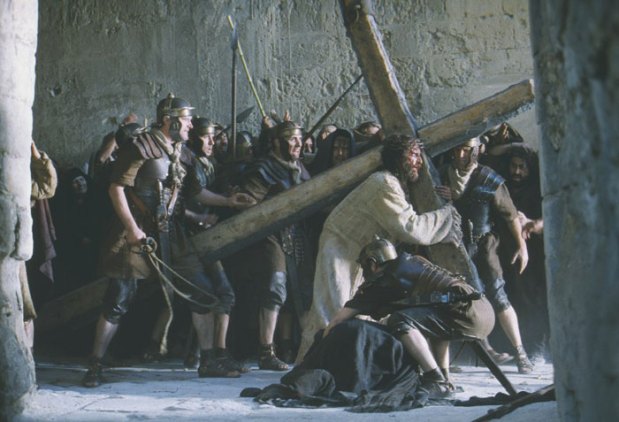
Jesus Christ

Away with Him! Crucify Him! Crucify Him!


Luke 23 (English Standard Version)

Jesus Before Pilate

Then the whole company of them arose and brought him before Pilate. And they began to accuse him, saying, “We found this man misleading our nation and forbidding us to give tribute to Caesar, and saying that he himself is Christ, a king.” And Pilate asked him, “Are you the King of the Jews?” And he answered him, “You have said so.”Then Pilate said to the chief priests and the crowds, “I find no guilt in this man.” But they were urgent, saying, “He stirs up the people, teaching throughout all Judea, from Galilee even to this place.”

Jesus Before Herod

When Pilate heard this, he asked whether the man was a Galilean. And when he learned that he belonged to Herod’s jurisdiction, he sent him over to Herod, who was himself in Jerusalem at that time. When Herod saw Jesus, he was very glad, for he had long desired to see him, because he had heard about him, and he was hoping to see some sign done by him. So he questioned him at some length, but he made no answer. 10 The chief priests and the scribes stood by, vehemently accusing him. 11 And Herod with his soldiers treated him with contempt and mocked him. Then, arraying him in splendid clothing, he sent him back to Pilate. 12 And Herod and Pilate became friends with each other that very day, for before this they had been at enmity with each other.

13 Pilate then called together the chief priests and the rulers and the people, 14 and said to them, “You brought me this man as one who was misleading the people. And after examining him before you, behold, I did not find this man guilty of any of your charges against him. 15 Neither did Herod, for he sent him back to us. Look, nothing deserving death has been done by him. 16 I will therefore punish and release him.”

Pilate Delivers Jesus to Be Crucified

18 But they all cried out together, “Away with this man, and release to us Barabbas”— 19 a man who had been thrown into prison for an insurrection started in the city and for murder. 20 Pilate addressed them once more, desiring to release Jesus, 21 but they kept shouting, “Crucify, crucify him!” 22 A third time he said to them, “Why, what evil has he done? I have found in him no guilt deserving death. I will therefore punish and release him.” 23 But they were urgent, demanding with loud cries that he should be crucified. And their voices prevailed. 24 So Pilate decided that their demand should be granted. 25 He released the man who had been thrown into prison for insurrection and murder, for which they asked, but he delivered Jesus over to their will.

The Crucifixion

26 And as they led him away, they seized one Simon of Cyrene, who was coming in from the country, and laid on him the cross, to carry it behind Jesus. 27 And there followed him a great multitude of the people and of women who were mourning and lamenting for him. 28 But turning to them Jesus said, “Daughters of Jerusalem, do not weep for me, but weep for yourselves and for your children. 29 For behold, the days are coming when they will say, ‘Blessed are the barren and the wombs that never bore and the breasts that never nursed!’ 30 Then they will begin to say to the mountains, ‘Fall on us,’ and to the hills, ‘Cover us.’ 31 For if they do these things when the wood is green, what will happen when it is dry?”

32 Two others, who were criminals, were led away to be put to death with him. 33 And when they came to the place that is called The Skull, there they crucified him, and the criminals, one on his right and one on his left. 34 And Jesus said, “Father, forgive them, for they know not what they do.” And they cast lots to divide his garments. 35 And the people stood by, watching, but the rulers scoffed at him, saying, “He saved others; let him save himself, if he is the Christ of God, his Chosen One!” 36 The soldiers also mocked him, coming up and offering him sour wine 37 and saying, “If you are the King of the Jews, save yourself!” 38 There was also an inscription over him, “This is the King of the Jews.”

39 One of the criminals who were hanged railed at him, saying, and “Are you not the Christ? Save yourself and us!” 40 But the other rebuked him, saying, “Do you not fear God, since you are under the same sentence of condemnation? 41 And we indeed justly, for we are receiving the due reward of our deeds; but this man has done nothing wrong.” 42 And he said, “Jesus, remember me when you come into your kingdom.” 43 And he said to him, “Truly, I say to you, today you will be with me in Paradise.”

The Death of Jesus

44 It was now about the sixth hour, and there was darkness over the whole land until the ninth hour, 45 while the sun’s light failed. And the curtain of the temple was torn in two. 46 Then Jesus, calling out with a loud voice, said, “Father, into your hands I commit my spirit!” And having said this he breathed his last. 47 Now when the centurion saw what had taken place, he praised God, saying, “Certainly this man was innocent!” 48 And all the crowds that had assembled for this spectacle, when they saw what had taken place, returned home beating their breasts. 49 And all his acquaintances and the women who had followed him from Galilee stood at a distance watching these things.

Jesus Is Buried

50 Now there was a man named Joseph, from the Jewish town of Arimathea. He was a member of the council, a good and righteous man, 51 who had not consented to their decision and action; and he was looking for the kingdom of God.52 This man went to Pilate and asked for the body of Jesus. 53 Then he took it down and wrapped it in a linen shroud and laid him in a tomb cut in stone, where no one had ever yet been laid. 54 It was the day of Preparation, and the Sabbath was beginning. 55 The women who had come with him from Galilee followed and saw the tomb and how his body was laid. 56 Then they returned and prepared spices and ointments.

On the Sabbath they rested according to the commandment.

Are you burdened with the weight of unforgiveness?


English: White tulips

Image via Wikipedia

For if you forgive others their trespasses, your heavenly Father will also forgive you, but if you do not forgive others their trespasses, neither will your Father forgive your trespasses” (Matthew 6:15-15).

One weight that God does not want you to carry is the weight of unforgiveness. Yet many in the body of Christ find it difficult to forgive. Unforgiveness not only affects your spiritual growth, but it also weighs heavily on your emotional and physical well-being.

The apostle Peter, a faithful disciple of Jesus Christ, and a stalwart of the early Church, struggled with the weight of unforgiveness. He hated the Gentiles. He referred to them as common and unclean. He even refused to preach the gospel to them. There is no evidence that the apostle Peter ever reconcile his differences with the Gentiles.

In the book of Matthew chapter 18:21-22, Jesus uses Peter’s struggle to teach us how to forgive. If we followed His instructions the world will be a better place:

Then came Peter to him, and said, Lord, how often shall my brother sin against me, and I forgive him? Till seven times?

Jesus saith unto him, I say not unto thee, until seven times: but, until seventy times seven

Unforgiveness is an attitude of the heart that abides outside the law of love. To walk in forgiveness is to walk in great spiritual freedom. Your heart is light when it does not carry grudge, bitterness, or resentment. To forgive does not mean that you agree with the offence that someone has committed, or that you support it in any way.

To forgive means that you choose to release the judgment you are carrying toward someone, even though that person did something that was unkind or unfair. The choice to forgive is not based on fairness or justice, but on mercy and grace. Mercy triumphs over judgment when you choose to forgive. Jesus did not carry any grudge against the people who nailed Him to the cross. Instead, He showed mercy by saying; “Father, forgive them, for they know not what they do” (Luke 23:34).

The reason for the Cross


Jesus Christ Crucifix

Image via Wikipedia

“The law is only a shadow of the good things that are coming—not the realities themselves. For this reason it can never, by the same sacrifices repeated endlessly year after year, make perfect those who draw near to worship. Otherwise, would they not have stopped being offered? For the worshipers would have been cleansed once for all, and would no longer have felt guilty for their sins. But those sacrifices are an annual reminder of sins. It is impossible for the blood of bulls and goats to take away sins.

Therefore, when Christ came into the world, he said:

Sacrifice and offering you did not desire,
but a body you prepared for me;
with burnt offerings and sin offerings
you were not pleased.
Then I said, ‘Here I am—it is written about me in the scroll—
I have come to do your will, my God.

First he said, “Sacrifices and offerings, burnt offerings and sin offerings you did not desire, nor were you pleased with them”—though they were offered in accordance with the law. Then he said, “Here I am, I have come to do your will.” He sets aside the first to establish the second. And by that will, we have been made holy through the sacrifice of the body of Jesus Christ once for all” (Hebrews 10:1-10)

Man by himself cannot deal with his own guilt or sin problem. He must have help from the outside.

In order to forgive himself, he must have forgiveness from the one he has offended. Yet man is unworthy to ask God for forgiveness.

That then is the reason for the cross. The cross did what sacrificed lambs could not do. It erased our sins, not for a year, but for eternity. The cross did what man could not do. It granted us the right to talk with, love, and even live with God.

You can’t do that by yourself. I don’t care how many worship services you attended or good deeds you do. Your goodness is insufficient. You can’t be good enough to deserve forgiveness. Not me, not you, not anyone! The Bible states in Romans 3:23 “For all have sinned, and come short of the glory of God.”

And that is why you and I need a savior in Jesus Christ. “For Christ also suffered once for sins, the righteous for the unrighteous, that he might bring us to God, being put to death in the flesh but made alive in the spirit” (1 Peter 3:18).

Do you think you should blame God for anything?


English: Abraham Sees Sodom in Flames, circa 1...

Image via Wikipedia

“For I know the plans I have for you,” declares the LORD, “plans to prosper you and not to harm you, plans to give you hope and a future” (Jeremiah 29:11, NIV).

I cannot possibly put a number on how many times I have heard people of all stripes blamed God for tragic events that have occurred in their lives. It is a common practice for people to blame God for unexpected tragedy or natural disaster. Christian or secular, the question is always; why? Why did God allow this or that? Why did God send this or that? Why? Why? Why didn’t God stop this or that? Some people even attempt to use tragic events to prove there is no God.

Frankly speaking, I do not think you should blame God for anything. He is a fair and just God, and whatever He promises He will do. In the days of Noah, He promised a great flood and the flood came. In the days of Abraham, He promised to destroy Sodom and He did.

God never promised us earthquakes, and tornadoes, typhoons and tsunami. He never promised diseases—heart attack, brain tumor or cancer. He promises eternal life and eternal damnation: “For the wages of sin is death; but the gift of God is eternal life through Jesus Christ our Lord” (John 6:23). “Do not be amazed at this, for a time is coming when all who are in their graves will hear his voice and come out—those who have done good will rise to live, and those who have done evil will rise to be condemned” (John 5:28-29).

Recently I stumbled upon a religious radio program—just in time to hear the preacher‘s comments on a friend of his whose wife was stricken with cancer. The preacher stated that his friend approached him and asks him why God allowed his wife to get cancer. His response was rather surprising! I thought he was going to say he did not know; as that would have been my choice, and the easy way out. Instead, the preacher said he told his friend that sickness and disease are not in God’s plan for us. He then quoted Jeremiah 29:11: “For I know the plans I have for you,” declares the LORD, “plans to prosper you and not to harm you, plans to give you hope and a future” (Jeremiah 29:11, NIV).That is reassuring? I thought to myself. I suddenly realized that all the myths and misconceptions about God are a result of lack of knowledge about God’s Word.

God is a just God; He will never do anything that He did not promise. Tragedy and disaster brings misery but misery is not in God’s blueprint for us.

The Vine and the Vinedresser


Smith's later theology described Jesus and God...

Image via Wikipedia

I am the true vine, and my Father is the vine-dresser. Every branch in me that does not bear fruit he takes away, and every branch that does bear fruit he prunes, that it may bear more fruit. Already you are clean because of the word that I have spoken to you.

Abide in me, and I in you. As the branch cannot bear fruit by itself, unless it abides in the vine, neither can you, unless you abide in me. I am the vine; you are the branches.

Whoever abides in me and I in him, he it is that bear much fruit, for apart from me you can do nothing. If anyone does not abide in me he is thrown away like a branch and withers; and the branches are gathered, thrown into the fire, and burned.

If you abide in me, and my words abide in you, ask whatever you wish, and it will be done for you. By this my Father is glorified, that you bear much fruit and so prove to be my disciples. As the Father has loved me, so have I loved you. Abide in my love. (John 15:1-10, ESV).

There is something that you can always be certain of as you abide in the vine—Jesus Christ and God  the father are deeply and intimately involved in your life; and they will never leave you nor forsake you.

The relationship of a branch to a vine signifies one of the closest relationships possible in creation. The branch is in the vine, the life of the vine is in the branch, and the vine-dresser [Jesus] is cutting back everything [the baggage] that will hinder it [you] from bearing much fruit.

Jesus uses the relationship of the branch and the vine to remind you of how dependent you are upon Him.

Like branches on a vine, our Christian life is a growth process. We mature more every day. As we abide in Jesus, we learn to know him better and trust him more. Cautiously, we reach out to others. We love them. The greater our trust in Christ, the greater our compassion will be.

This is a lifelong challenge. When we are rebuffed, we have the choice to draw back or give our hurt to Christ and try again. Abiding is what matters. When we live that truth, we can begin to love like Jesus.

Jesus doesn’t command you to bear fruit, but He does command you to abide in Him. Fruit is the outcome of your abiding, and that fruit will always glorify the father.